Sunday, 13 October 2013

Interlopers & more 18th century planting plates ...

interlopers in the orangery field

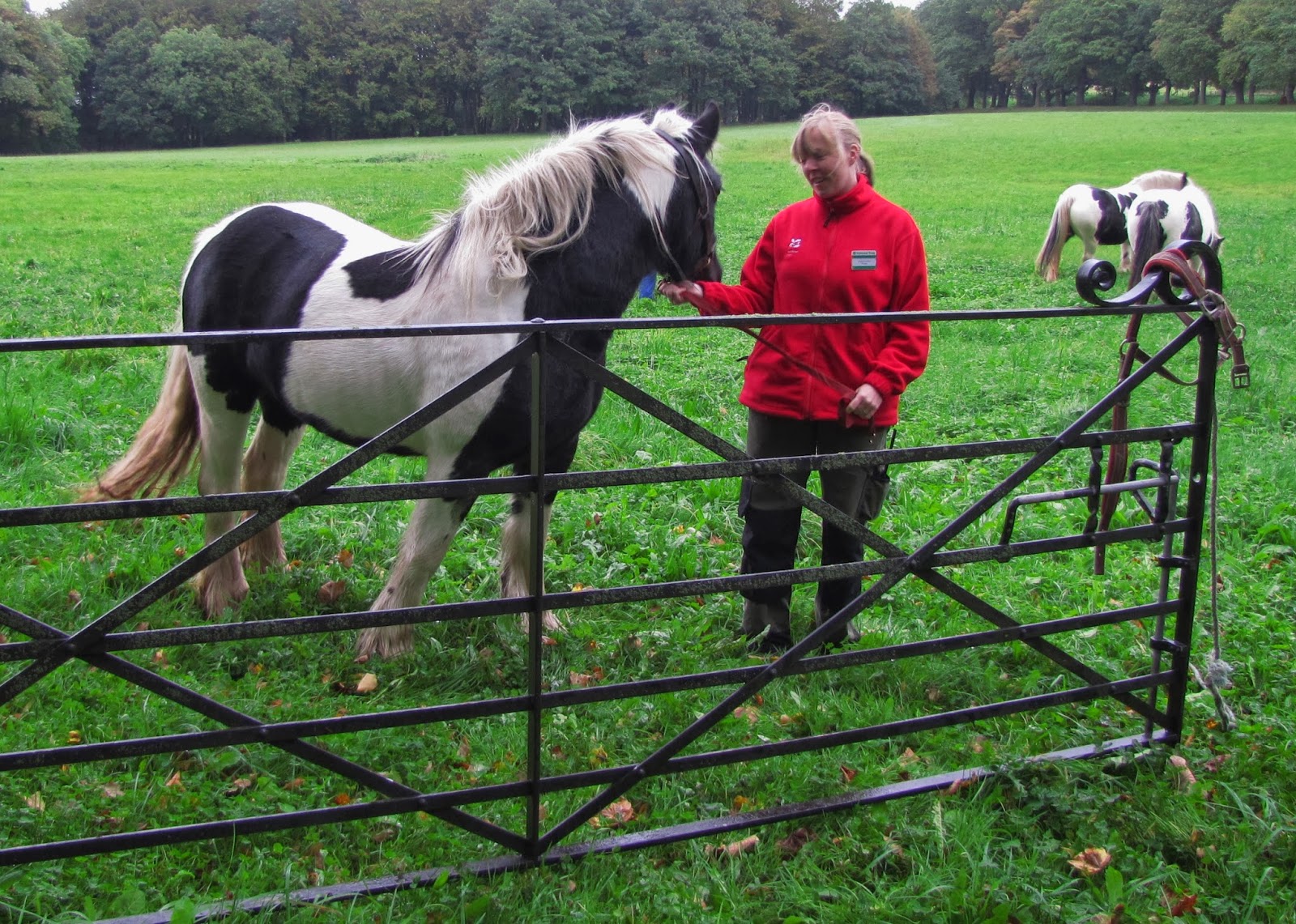
One of the best things about working at Gibside is that you never know what might happen on any given day. Saturday proved a case in point, as we arrived at work to find 4 horses happily munching away at the clover in the field in front of the orangery. Fortunately Vicky, one of our rangers, recognised the horses and was able to contact the owners and let them know about their escapees. The horses had managed to get through a gap in the fence, cross over the river, and find their way to that fabled land where the grass (or the clover at least) is greener.
Vicky holding the first "recaptured" horse
The horses were surprisingly easily cajoled away from the clover once their owners arrived with softly scolding voices and a big bucket of corn. The four were put into halters and led through the gate and back into their horse box with the minimum of fuss, and Gibside's Saturday morning returned to normal again.
more 18th century planting plates exposed
Regular visitors may have noticed that we've been doing more digging in the walled garden behind the Community Farm plots. A group of Newcastle University archaeology students have been in to practise their fieldwork skills and help to expose 8 more of our original 18th century planting plates (see this post for more detailed information). Whilst our geophys survey suggested there should be 8 plates, we've only managed to find 4. One of the plates we've found actually has stone slabs missing, which leads us to conjecture that the missing plates had all their slabs removed, possibly for use elsewhere on the estate. After the plates have been recorded and the holes refilled, we plan to replant this edge with apple cordons.
herbaceous border re-vamp plans
With the arrival of October comes the slowing down of the growing season, and our thoughts are already turning to next year. We'd like to give our large herbaceous border a bit of a make-over, as some of the plants are becoming congested and others have really outstayed their welcome. It's an exciting process, mapping the existing plants and deciding what should stay and what will go, before the real fun starts and we can choose what new perennials will replace them. We need to restrict our choice of plants to those that were introduced into the UK before the mid 1800s; this allows us to offer a glimpse into what the border would have looked like in its heyday.
Kniphofia rooperi
This week I leave you with the fizzing bright yellow and orange spikes of the red hot poker, Kniphofia rooperi, just coming into flower in the orangery. It's a garden plant that looks exotic but is quite capable of withstanding our cold winters and putting on a dazzling show when most other perennials are past their best. Its flowers and sword-like leaves look particularly impressive against the brickwork and they should be in full bloom over the next week or two.

This October take the chance to see our 18th century planting plates before they're buried once more, and catch our red hot pokers defying the autumnal chill with their warming glow.

Saturday, 5 October 2013

The volunteering life ... meet Maureen

At "70 something and a few", with 10 years at Gibside, Maureen Lawler is one of our longest serving volunteers. She has her own plot with fellow volunteer Sylvia, growing fruit and vegetables, and tends the lovely cut flower bed too!
Maureen deadheading in the cut flower bed

After my husband died, my son suggested that I might want to do some voluntary work, and he thought that Gibside might be a good place to try that. Approximately 10 years ago I started work with a "foot in both camps" selling raffle tickets on Sundays, and at the large music concerts that Gibside used to hold, and working in the Walled Garden on Wednesdays. Selling raffle tickets at the concerts was great fun as there were so many different people to meet, but unfortunately this came to an end, as the concerts stopped, and so did my Sunday bus service!

I continue to work in the Walled Garden on a Wednesday and still really enjoy this. There have been vast changes from the small plots that we started with and hopefully the garden will soon be fully restored.

busy in the veg plot ...
I find the whole experience very enjoyable - especially chatting to the visitors. Everyone is always so interested in what is going on and what flowers and crops we are growing. The work is varied too and no two weeks are the same, although there is always weeding to be done. Where do they all come from? At the moment, I am busy working on the cut flower bed and my own plot; there is harvesting, cutting back and planning for next year to be done.

The gang I work with are great fun, very friendly, helpful and supportive and I would never want to swap them!

I'm not sure how much longer I will be able to contribute bearing in mind that I am now 70 something and a few but my plan is to go on as long as I can.

Maureen Lawler

Thursday, 3 October 2013

Mini Mammals


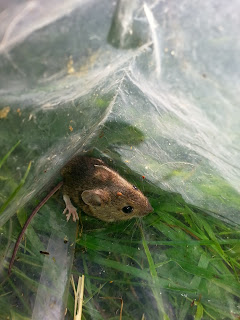
Mini mammals are a group of mammals that are under recorded across Britain, these include the mice; house mouse, harvest mouse, yellow-necked mouse and wood mouse. The shrews; common shrew, pygmy shrew; water shrew, lesser white-toothed shrew, greater white-toothed shrew and Millet’s shrew. The voles; bank vole, field vole and Orkney & Guernsey vole.

To help increase our knowledge of the distribution of mini mammals The Mammal Society started a national survey to get everyone involved in their local area. As mini mammals had not been surveyed at Gibside before I decided to get the ball rolling and start the annual survey.

Myself, Veronica Carnell (a local mammal expert) and Catherine Robson (one of our volunteers who has recently completed her Master disertation on water shrew populations) chose two sites within the grounds, the quarry site and ladyhaugh meadow. 10 longworth traps where set up in each site in a line 1m apart. Bait and hay were put in each trap and left locked open for 24 hrs so that the mammals got used to them. We used sunflower seeds, pieces of apple and casters for bait. Casters are the next stage in the life cycle of a maggot. They are the chrysalis of a maggot, a shell-like pupae that contains the soon-to-emerge fly.


The following evening we replenished the bait and hay then set the traps to lock when the treadle inside the trap was touched. 7am the following morning we came back to see what we had caught. If the door to the trap was shut we carefully put the trap inside a big plastic bag to open them, this was just to stop the mammal from jumping out and getting hurt. The traps were opened and the contents carefully emptied out into the bag so we could see what we had caught.  


Wood Mouse


Common Shrew
At the quarry site we caught 4 bank voles and 2 wood mice and at ladyhaugh meadow we caught 3 wood mice and a common shrew. This data has been sent to The Mammal Society and will contribute to their national survey to plot the distribution of mini mammals. The data will also contribute to our own site records and as we repeat the survey each year we too will get a better picture of our mini mammals at Gibside.


Bank Vole


Monday, 30 September 2013

West Wood LWS survey Blog 4: Summer fades

25 September 2013


It was towards the end of a dull morning. Along the upper track through West Wood a few trees seemed to be bubbling with a flock of mixed tits including many long-tailed and, as if to emphasise the changing season, a dull, cool morning turned to rain. It was expected; weather forecasting is disappointingly accurate these days.

Some plants continue to flower – angelica, red campion and reliable herb robert among them – and devil’s bit scabious has come in to its own. The fading remains of the summer’s plants make fine practice for the amateur field botanist’s taxonomy skills. Some of us are best off with a show of flower to provide an initial clue.

Devil's-bit Scabious

Red Campion
 
Herb Robert
 
 
It has been an unusual season: a cold, slow start, then a surge of warmth and growth. The task for we wildlife surveyors had been, of course, to record whatever living plant or animal we found, but also, specifically, to track down a list of species designated as conservation performance indicators. That is, to review the state of this Local Wildlife Site to demonstrate that Gibside NT is doing its bit to take care of nature and thereby gain merit.

 
Red Bartsia

Speckled Wood Butterfly
Wolf Spider
 
With summer fading, it was time for a get together with the Estate’s rangers to compare findings. As predicted by our friendly local naturalist (see LWS Blog 3), we never did find lesser skullcap, and can’t be certain that there are tree pipits around. Otherwise all is well. We recorded some two hundred species but, undoubtedly, there is much we overlooked: mosses, lichens, pond life and vast numbers of insects. And autumn’s fungi are just emerging.
Acorn
Emerging Fungi

Blackberries


Steve Wootten & Phil Coyne

Saturday, 28 September 2013

The volunteering life ... meet John

John Watson has been volunteering in the conservation team for 2 years now and during that time has made new friends, learnt new skills and enjoyed being with nature. Here he introduces himself and explains the many aspects that make volunteering at Gibside such a rewarding experience.

John keeping the Shrubbery Walk grass in order
Gibside has really started to come to life this year, especially the walled garden and surrounding areas. Maintaining the estate along with the ongoing restoration of the pleasure grounds takes a small army of volunteers, coupled with the NT's own staff. Together we help to continue in the footsteps of George Bowes' garden, originally started way back in the early 1700s.

As a volunteer with the conservation team for the past 2 years, I have been involved in various tasks each week, maintaining various areas within the estate. This includes cutting grass, attending flower beds, planting and pruning different types of shrubs, extending pathways, and many other tasks associated with gardening in the grounds. The cottage garden which had been neglected over the past few years, was a low priority and needed renovating. I was given the task along with my colleague Mike, to develop this garden into a low maintenance garden. We have worked hard on doing this, under the supervision of Gardener in Charge Keith Blundell. The garden is now beginning to look more like a garden than a neglected wasteland!
the cottage garden John has helped transform

Being a volunteer at Gibside has many rewards such as working on the slopes of the Derwent Valley, being surrounded by wildlife, majestic trees, and the relentless progress of nature. Learning new skills is also a bonus. Another reward is the people that you meet, who are from different backgrounds and have different interests, and the comradeship between volunteers and staff is very important too. I have made several new friends over the last two years, one in particular, Mike, who I teamed up with as we both started volunteering at the same time. Mike has renewed my interest in playing golf, and I have influenced him into learning to play the guitar. I only started to learn myself at the age of 65 years - you're never too old to learn new skills, age is just a number!

John busy in the cottage garden
I have always loved gardening since my dad took me to my grandfather's allotment when I was just a child. Having worked in an office and factory environment as an engineering production manager most of my working life, it is wonderful to be outdoors especially next to nature in a place like Gibside. Besides gardening I am a keen DIY man and recently renovated a house (along with one of my old workmates) for one of my granddaughters  ... this gave me a great deal of pleasure. I frequently visit the local library and usually read crime and war stories. I tend to latch on to one particular author until I have read most of their books; at the moment I am midway through 20 bestsellers by David Baldacci - only 10 more books to go.

As one of many volunteers at Gibside, I feel that we're helping to keep the estate alive for future generations, as well as keeping ourselves active. I would recommend being a volunteer at Gibside to anyone, whatever age, young or old, and from whatever background.

John Watson

Sunday, 22 September 2013

Architecture, wildlife & the shoo-fly plant

At 20.44 this evening, the autumnal equinox will arrive here in the Northern Hemisphere, and summer is officially over. I confess autumn is my favourite season, and I welcome the coolness, the Keatsian "mists and mellow fruitfulness" (has anyone ever expressed autumn more perfectly?), but I know many people who don't feel the same way. Well, don't despair, whatever the season, there's always something happening here in the grounds at Gibside, and this week's blog takes a look at our secretive banqueting house, some interesting caterpillars and a plant that is the talk of the garden....

The Banqueting House
Built during the 1740s, Gibside's Banqueting House is an unexpected feature nestled in woodlands and looking down onto the Octagon Pond. It's Gothic in style, with a bowed front and decorative, castle-like crenellations. It was built as a place for surprise picnics and feasts, and to refresh guests after a tour of the grounds. Although it is quite small inside, the clever use of mirrors in the "Great Room" means that, according to a 19th century description, the room appears "almost endless in length".

The Landmark Trust owns the building and funded the four-year restoration project, which finished in 1981, and took the building from a dilapidated shell to its current state of grandeur. It is now rented out as a holiday let, and is open to the public one weekend a year as part of the Heritage Open Days scheme. 2013's open days have just ended, but it's well worth making a date in your diary for 2014, as Gibside is free to enter, and the chapel's crypt is open for viewing too!

caterpillar of the Buff-tip moth
We've been very lucky this year and suffered little from attacks of pest and disease in the walled garden, but last week Gardener in Charge Keith Blundell spotted these rather striking caterpillars happily munching on some beech trees. They are the larvae of the Buff-tip moth (Phalera bucephala), a common moth found in parks and gardens throughout the British Isles. The moth is silver-grey in colouring and its wings look almost like tree bark making it quite difficult to spot when at rest. A bunch of 20 or so of these caterpillars were making quick work of defoliating a few branches from one of our beech, but this damage is of no consequence to the tree itself as autumn is on the doorstep and it will soon be shedding its leaves. Here in the walled garden we're happy to trade a few leaves for the presence of these hairy caterpillars and the lovely moths they will become. Take a look at The Wildlife Trust's page on the Buff-tip moth for more information.


Nicandra physalodes, the shoo-fly plant

Finally, there is one particular plant that has been causing a stir for the last few weeks ... and it's the Apple of Peru, or shoo-fly plant, Nicandra physalodes. Nicandra is a native of Peru, and has large bell-shaped blue flowers that open out along the length of its arching stems. Perhaps more magnificent are its Chinese-lantern style fruits that appear after flowering and decorate the branches with mottled black and green "lanterns". Each of these lanterns contains a berry about the size of a marble that is filled with seed. Not surprisingly then, if you do plant a single Nicandra, you may well find yourself with dozens the following year! It's pretty easy to keep control by making sure you pull up the Nicandra before its seeds ripen and disperse, or to hoe out unwanted seedlings that germinate the next year. The seedlings have distinctive tooth-edges leaves and black speckles. This plant grows as an annual here in Britain, providing  flowers and fruit from June to October, and perhaps even repelling the odd insect or two (though we haven't tested this!), hence its common name: shoo-fly.

Whether you're interested in architecture, wildlife, flowers, or all three, why not come along to Gibside now that autumn's here and see what you can discover?

Tuesday, 17 September 2013

The volunteering life ... meet Helen & Bruce


From the benefits of growing in squares, to the riddles of the missing sprouts and strawberries, there's always something interesting to learn from our friendly volunteers. Here Helen & Bruce, volunteers and plotholders in the Walled Garden, share their experiences and reveal what makes Gibside such a big part of their lives.

Helen & Bruce on their walled garden plot
It all started with a trip to the loo in November 2004! We stopped off at Gibside for a cuppa after a local walk and I spotted a poster in the ladies asking for volunteers to work in the Walled Garden. Having fairly recently retired from Newcastle University Library, I was looking for volunteer opportunities, and being a keen gardener, this seemed just the thing. I rang the landscape manager at the time and she suggested I get back in touch in the Spring - so in April 2005 I joined the garden volunteers. After the first very rainy Wednesday spent sowing seeds in the greenhouse, the rest of the summer was hot and sunny, and I fell in love with the Walled Garden. At the end of the season, I was offered a plot of my own to tend - this was a great opportunity to begin growing vegetables again, as our own garden is too small for this, and I suggested my husband, Bruce, should come and volunteer too.

growing in squares is both attractive and practical
We have had our plot for 8 seasons now and have learnt a lot about what works and what doesn't. As we only come once a week, we have learnt that crops needing regular picking, such as beans, lettuce or radish, don't really work as they get too big or bolt; so now we go for crops that will stay in the ground or on the plant till we are ready, and that will store well, such as potatoes, onions, beetroot, borlotti beans. We still get gluts of course, and then it is great to be able to share the bounty with our fellow gardeners, and with the Tea Room. We have introduced perennial and annual flowers, for colour, for the bees and for pest control, and these draw many comments from our visitors, who love them, especially the Californian poppy, "Fruit Crush"! We like growing in squares, because it looks attractive and is practical for cultivation and harvesting. While on holiday in France this year, I found a book about gardening in squares within squares and would love to give this a try next year.

In winter, when the garden is put to bed, we join the conservation team, and have a wonderful time with good friends, chopping things down, building habitats and having big fires on cold frosty days. Gibside is a big part of our lives, and it is never anything but a privilege to come and work here. 

* * * * * * * * * * * * * * * * * * * * * * * * * * * * * * * * * * * * * * * * * * * * * * * * * * * * * * * * * * * * * * *


Bruce watering in new seeds
Gibside got under my skin, or finger nails to be exact, about 7 years ago. It was when Helen was offered a plot and she realised that she would need a gofer! I didn’t mind as I like the brawny stuff and it saves going to a gym. Do a good day’s work in the Walled Garden – digging, bending, weeding and wheel-barrowing - and you know the muscles will ache in the nicest possible way. So, I enjoy the planning of what we shall plant each year, I enjoy choosing the type of seeds, I enjoy planting and watching them grow (don’t mention the parsnips) and what else, oh! Yes, the eating of the tasty veg and fruit (don’t mention the strawbs). No, I will! We have grown strawbs for many years at home in a small way, so we brought some to our plot and the first year had a great crop; the second and third years, flowers then small fruits appeared, but three weeks later nowt. I think it may be a combination of humans ‘testing’ the produce or the grey squirrel Keith, the Gardener in Charge, has seen high-tailing it over the wall with a very strawberry coloured mouth.

sprouts provide a "tasty nibble" for passing deer
It’s great to be able to chat to other like minded people – visitors, staff and other volunteers. A lot of gardening tips get passed on. David, two plots along, told us about Pink Fir Apple potatoes and we tend to have a competition for who’s grown the funniest looking ones. Phil Younger, Ranger, told us how to get rid of the badger droppings. One Wednesday, last March, we found all the sprout plants eaten to the stems. Wow, it must have been a giant caterpillar; no, it was a deer that had got into the Walled Garden looking for a tasty nibble. Yes, we do have pests at Gibside but maybe not your common or garden ones.


Pink Fir Apple potatoes: funny looking but delicious
This year, we have had monster crops, with shoals of Pink Fir Apple potatoes - a delicious salad variety - huge round "courgettes" like footballs, massive swedes (all recipes for using swede gratefully received), and, we think, competition bench size parsnips. This must be mostly due to the wonderful summer, but also we started many veg off in modules. Keith taught us this trick of starting root veg, especially parsnips, off in containers and when best to plant out.

Summer’s all too soon over and we will be called on to help as part of the Conservation Team, working on all parts of the estate. Hard to say what this will encompass but I’m sure it will include cutting down trimming back rhododendron patches, collecting and making leaf compost and maybe planting a few shrubs. But always having a chat and meeting friendly people. Wednesdays are good days!

Helen & Bruce MacFarlane