Gibside
Blog May 2020
As city dwelling goes, we two are pretty well-placed for
greenery with the Park and the Town Moor. And wandering the tree-lined streets
of posh-Gosforth is good too, though house envy can be a bit of a struggle. Jesmond
Dene is within walking distance, and there other green gems to be rediscovered
and explored. Old cemeteries are a favourite - peaceful, beautiful wildlife
havens.
As well as being long-serving members of the Gibside
Rangers’ Wednesday Volunteer Team, we two also work in our local park where,
along with one other amateur naturalist, we look after the Wildlife Area.
Currently, of course, all volunteer work has stopped – though there is a little
bit of guerrilla nature conservation going on. We can, though, visit the park
and our Wildlife Area as members of the public. Whilst mostly that is a great
pleasure, it is also frustrating not to be able to provide the care and
attention needed – especially at this time of year.
Gosforth Central Park is a public park popular with
dog walkers (and their dogs), children, the occasional vandal and the rest
of the local population, so we have to strike a balance between managing
the area for wildlife and for public access and enjoyment. That creates its own
problems. The pond and its immediate surroundings are fenced – dog-proofed and
child-proofed, and pretty much safe from big people as well. The rest of the
Wildlife Area is open to roam and, without the grass cutting to define paths
and protective sticks and string to protect vulnerable vegetation, it is being
trampled over and biked on. And pandemic lockdown has brought an increase in
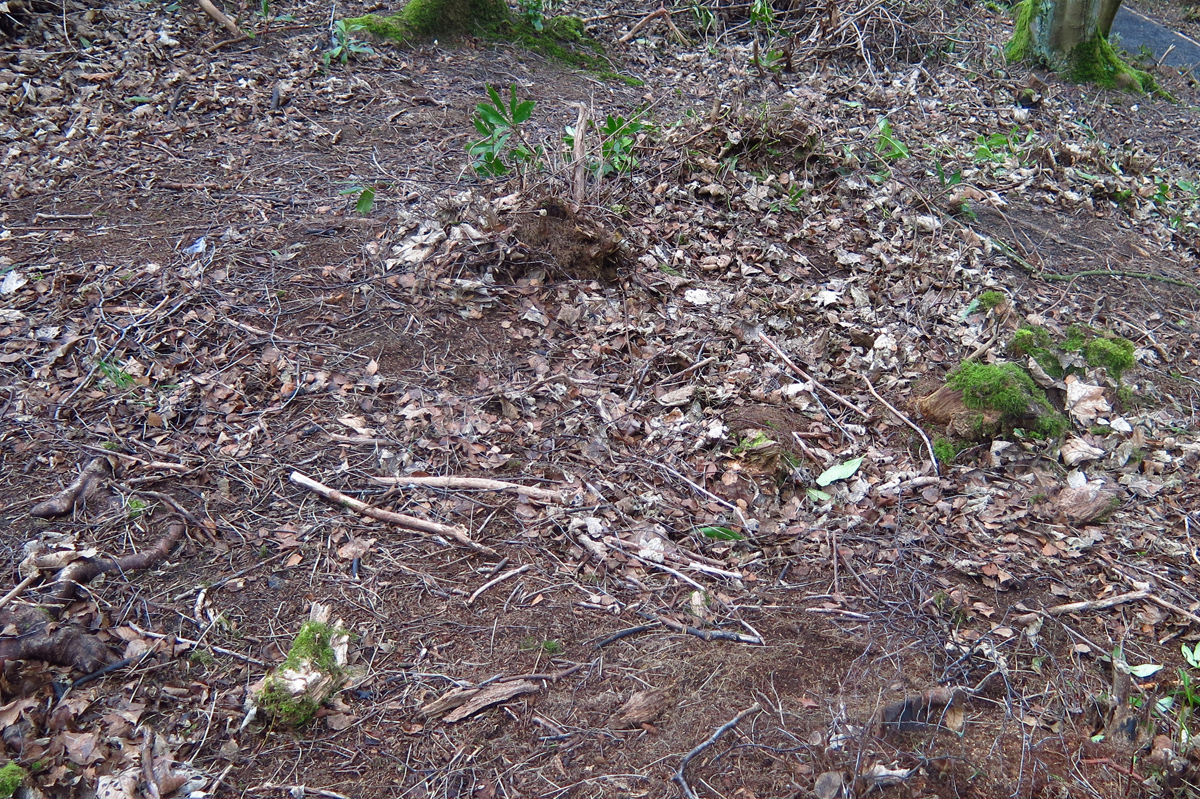
footfall. Newly seeded patches have come to nothing for want of rain, and the
water level in the pond is worryingly low. But that’s nature for you. The Wildlife
Area has a disappointingly meagre population of invertebrates. For example, it
seems odd that we have no ants. We would like to do something to remedy that,
but not this year, it seems.
 |
| The Town Moor Newcastle |
 |
| Cows on Dukes Moor, Newcastle |
 |
| Dreaded rhododendrons in Leases Park, Newcastle |
Behind the closed gates of the Gibside Estate things are
very different. Undisturbed by visitors, wildlife is thriving. We do miss our
privileged days there. The Rangers do their bit to keep us in touch with
nature, but it’s not the same. To remind us of what we are missing, we’ve been
looking back at some of our earlier blog entries for the months of April and
May. You can read them for yourself, of course, but here are some extracts and
some pictures.
Dog’s mercury, though abundant in our woodlands and one of
the earliest plants to flower, can go largely unnoticed. Its flowers are small,
green and have no petals. As a herald of spring, it doesn’t make much of an
impression, but it’s soon joined by other, more impressive, flowers carpeting
the woodland floor – golden saxifrage, wood anemone, wood sorrel and ramsons.
Elsewhere primrose, lesser celandine, coltsfoot, and dandelion make a fine
show.
The oddly delicate moschatel has its five flowers set at
right-angles to each other – like clock faces with an extra one on top.
Previously recorded along the riverside path and in the woods at the northern
end of Ladyhaugh, it has this spring appeared in a swathe near the Lily Pond.
It’s small and beautiful but, being almost entirely green, is easily
over-looked.
It’s April, and the animal world is preparing for the new
season. Frogs have long since spawned, and tadpoles have started to emerge from
their gelatinous mess; numerous toads tangle in the ponds, seeking mates;
peacock and small tortoiseshell butterflies have started their wanderings; and
common carder bumblebees glide the woodland fringes; chiffchaffs seem to be
everywhere.
 |
Dog's mercury
|
 |
| Wood anemone |
 |
| Moschatel |
Gibside Blog: 27 April 2016: Spring gets going
Hidden away in the new birch growth in the West Wood, Terry
and Steve sought out a large and rather well-constructed log pile. Phil took
Terry’s picture standing beside it. This had been the very first job for the
Wednesday Conservation Team – nearly ten years ago now. We sized it up, admired
its construction, exchanged memories of the day, and tried to remember who had
been there with us. Phil looked on politely – neither bored nor in wonder; he’s
only been coming here for eight years.
We were in the West Wood, mapping a grass snake site. That
is plotting the position of a heap of rotting vegetation which is there to
encourage snakes to lay their eggs in a place where we can find them, and
noting the position of pieces of corrugated iron sheet which are intended to
provide a good warming-up spot for our cold-blooded reptiles. Each sheet is
numbered to help us record what we find on it, or under it, during our weekly
observations. There are eight such sites around the estate.
A few weeks ago, Ranger Liam helped us set up one of the
sites on Warrenhaugh by carting some bales of straw in a vehicle referred to as
the ‘Mule’. Going downhill was fine but, job done, the creature couldn’t cope
with the wet, stony slope. We pushed it – and Liam - backwards seven-eighths of
the way up the hill before admitting defeat, and summoning a Land Rover to tow
it the rest of the way. Liam was rightly embarrassed, and would rather people
didn’t know about it.
As spring gets going, it’s time for us to abandon our winter
labours, and leave nature in peace. From now through to October we will be
taking leisurely strolls with binoculars and note book, sandwiches and flask,
recording flora and fauna for the Trust’s database. We might even see a grass
snake.
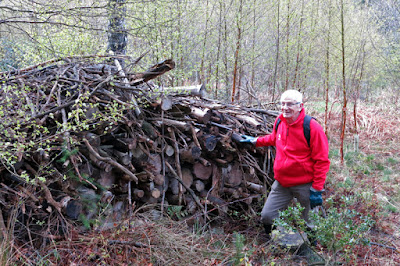 |
| Terry stands nest to the log pile |
 |
| West woods nest heap |
 |
| The West Woods grass snake site |
Gibside Blog 4 May 2016: A new start
Through to mid-morning it was still cool enough to wear our
fleece jackets; by lunchtime the temperature had risen to sixteen or seventeen
degrees. This year, that counts as hot. We had a few small jobs to get done,
but this was the day to return to our summer job of collecting wildlife data
around Gibside Estate. What we see, we note. We transfer our notes to a
spreadsheet which we add into the Rangers’ data, and all that gets fed into the
National Trust databank. It’s a useful task we’re told, but, in truth, we do it
because we like to.
In a few weeks, Ladyhaugh will be coloured with
meadow flowers. Today we noted a few. Cowslips dominate, along with the odd
patch of primrose and a scattering of lesser celandine and dandelion. The
margins of the meadow are less showy, but display more variety with a few
bluebells, greater stitchwort, garlic mustard, wood anemone, and daisies of
course. At the rough, north end, we sought out butterbur - now fading beside
the river, and found a patch of ground ivy that we had not noted in previous
years. An orange tipped butterfly fluttered by; a welcome start to a new
season.
 |
| Lesser celandine |
 |
| Greater stitchwort |
 |
| Bugles |
 |
| Butterbur |
Gibside Blog 11 May 2016: Out-witting sheep
As a rule, sheep are docile, unimaginative creatures,
capable of no more than munching grass all day, reproducing once a year, and
occasionally falling over with their feet sticking up in the air. It’s their
upbringing, you see. Natural selection has long since been replaced by farmer
selection. They are bred for the quality of their meat and wool, their
reproductive success rate, and their good looks – so that they can win prizes
in agricultural shows. Wit and survival skills are not selection criteria.
It was unexpected then that, after all our hard work, sheep
dismantled a gate at the penned-in Warrenhaugh Pond, kicked sticks and straw
out of the way, and ate all the green grass cuttings from the grass snake nest
heap. It’s repaired now, and defences strengthened using hammer, nails and
string. We know how to out-wit sheep.
 |
| It wasn't us guv. |
 |
| The nest heap being repaired |
 |
| The gate is now repaired |
Gibside blog April - May 2017: Grass snake (Natrix natrix)
The new tins had been numbered with Roman numerals. One of
the rangers must have done that. They’re a sophisticated lot. We’ve been back
in one of the more remote parts of the Gibside woodland, cutting back the
tangle of bramble and honeysuckle that had taken advantage of the clearings we
had carved out earlier in the year. We lopped down a few more birches while we
were on, to let in more light. It is grass snake time again, and we were there
to set up a new monitoring site in addition to the eight already dotted around
the estate.
This site is a bit out of the way, bordered north and south
by intermittent streams, and surrounded by trees – oak, rowan, ash, beech, wych
elm, holly, hazel and lots of birch. Though predominantly trees, there are
margins – streamside, field edge, nearby track side and, of course, the
clearings themselves – where non-woody flowering plants thrive. Here there are
bluebells, wood sorrel, ramsons, primrose, yellow pimpernel and the exquisite
moschatel. In some parts, people refer to grass snakes as water snakes.
Hereabouts there are a few ponds, and we’re not too far from the River Derwent
– though it is uphill all the way. The streams might help.
Anyway, with it being a new patch, it has new ACOs –
artificial cover objects that is: bits of corrugated iron. These days they’re
made of some other material, but we just call them tins.
The tins are there because, underneath, they make an ideal
grass snake shelter and, on top, a fine basking place, making any snakes more
visible to the observer. The numbers aid recording. And Natrix natrix might
well be tempted by the Roman numerals, but don’t count on it.
 |
| Log pile covered in honeysuckle |
 |
| A lovely wych elm tree near site entrance |
 |
| Bluebells |
 |
| Yellow pimpernel |
 |
| Ramsons |
Just the day before, Ranger Helen had watched three red
kites squabbling high above Gibside. Engaged in a dog fight (for want of a
better metaphor), the two males locked talons and plummeted into the trees,
risking serious injury in pursuit of a mate. Late March: it’s that time of
year.
In the Ice House Woods blackbirds scuttled and a couple of
wrens flitted around in path-side shrubs. Wood anemones planted in their
thousands here last autumn are pushing up their first leaves among the first
signs of wood sorrel and cuckoo pint. Dog’s mercury, lesser celandine and yew
are in flower. A nuthatch rehearses being noisy and appealing. At a distance
trees still look wintery but, here in the woods and along the Avenue, they too
are unfurling their leaves in readiness for the start of nature’s year.
In the air above the Octagon Pond, a buzzard, red kite and
kestrel all appeared at the same moment separated vertically and horizontally
by some invisible air controller. It was a photo lost to a slow camera and a
slower wit. On the pond, coots were preparing to nest. In the pond were frogs,
frogspawn and knots of toads. It’s that time of year.
On a rainy day that ought to have kept us at home, we
wandered Ice House Dene Woods once more to check out the wood anemone. It was
cold - exceptionally cold for May. There was a gentle breeze that nevertheless
allowed the rain to fall straight down in a tolerable fashion, pleasant even.
We walked on to the riverside by Ladyhaugh. Ranger Phil had seen otters here
recently, but not today. We were cheered, though, by the sighting of a dipper
mid-stream and a roe deer grazing in the open – made bolder with the rain
keeping visitors and dog walkers away.
We wandered on making a mental note of plants and birds, and
stopped off in the dry of the bird hide to write down what we could remember
over a sandwich and cup of coffee. Bedraggled woodpeckers monopolised the
feeders. Below, a young chaffinch was being fed by mum. It’s that time of year.
 |
| Nuthatch |
 |
| Wood sorrel flower heads |
 |
| Toads "tying the knot" |
 |
| A mass of bluebells on the edge of Ladyhaugh |
 |
| Horsetails - Lily Pond |
 |
| Coot on nest with young - Octagon Pond |
 |
| Hawthorn beginning to flower |
There will be plenty of work to do when we eventually return
to Gibside. Meanwhile we hope that you enjoyed the blast from the past.
Keep safe. Keep healthy.
Steve Wootten & Phil Coyne