Wednesday, 28 September 2011

Pale Tussock Moth

Pale Tussock Moth Caterpillar

This brightly-coloured caterpillar was found today by one of our volunteers.  It's a Pale Tussock Moth caterpillar.  The moth is a much duller brown and pale-coloured. 
The caterpillar feeds on oaks and lime trees until October when it will spin its silk cocoon and overwinter as a pupa. 
A beautiful creature!

Monday, 19 September 2011

Repairing the riverside path

Last week we were working with a contractor to begin clearing the landslide that has closed the popular riverside walk for over a year. Gibside's built on a valley side which is doing its very best to fall into the river Derwent and this repair project is part of our on-going effort to keep the riverside walk open.


The project has taken so long to get to this stage as we have worked with engineers to make sure the area is safe and that we can repair the collapse without putting anyone at risk. In the next few weeks volunteers will work with walling contractors to re-build the wall and then repair the footpath. All being well we should have the route opened again by the end of October, which will let everyone once again enjoy the riverside walk.

Wednesday, 14 September 2011

Felling trees

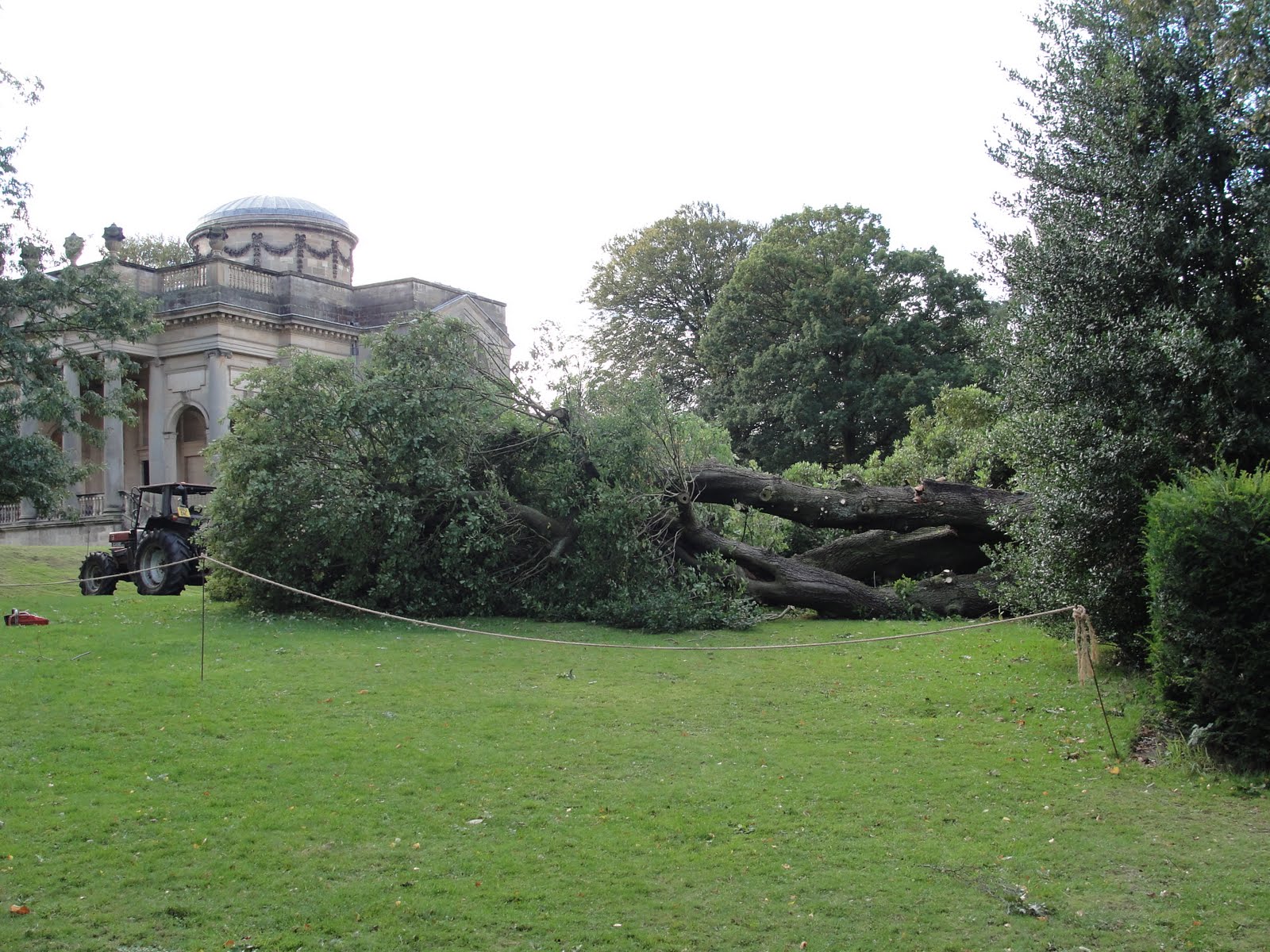
A large oak tree near our visitor reception has been felled today.

The tree has been braced with cables in the past, and dead branches have been removed to try and prolong it’s life.  The tree was tested by the National Trust foresters from Cragside – they have equipment that can send sound waves though the tree trunk, and they can tell how solid the wood is from the speed at which the sound waves travel.  The test showed that the tree has less than 25% solid wood left in the trunk, so it is no longer safe to leave it standing in such a busy visitor area, next to the reception building and Chapel Cottage.

We are felling it now because it is past bird-nesting time, and before the wet and windy autumn and winter weather begins.  There are many holes and cracks in the tree, so we carried out a dawn bat survey this morning to make sure no bats went into the tree to roost.  The tree surgeons also double-checked and looked inside all the holes with an endoscope before work began.

Now the tree is felled, we will grind out the stump, and another English Oak will be planted in its place.
The rotten trunk and stump of the oak tree.

The felled tree near the Chapel.

Thursday, 8 September 2011

Badgers in the woodland


We filmed this badger disappearing down into his sett using a motion sensor camera in the woodland.  You can look at more video footage of badgers and squirrels on our website wildlife pages at  www.nationaltrust.org.uk/gibside

There are badger setts all over Gibside.  We don't often get to see the badgers themselves, but we do see the signs they leave.  There are badger paths leading up to the fields where they go at night to search for worms and slugs.  There are also signs in the Walled Garden, when they break through the mesh on the gate to get to the wind-fall apples!

If you'd like to find out how to spot animal tracks and signs you can come along to our Winter Wildlife Tracking walk on Sunday 13th November, when our ranger Phil will show you what to look out for.

Wednesday, 31 August 2011

Wildlife Wednesday Bird Ringing

This morning, at our Wildlife Wednesday bird ringing demo, Richard, our ringer, caught a sparrowhawk in the mist net.
Richard with the sparrowhawk

It was a male bird, so much smaller than a female sparrowhawk.  He was in the middle of molting his feathers so we saw the difference between the new, brighter feathers and the older, dull ones.  After he was measured, weighed and ringed he was then set free again.  He was a beautiful bird with sharp talons and beak, and fierce eyes.


The bird ringing sessions have been successful, attracting lots of visitors who get to see the birds close up, and learn about birds and ringing.  One of the things that we have found out during the bird ringing sessions is that there are 24 different robins feeding in the woodlands behind the stable block!  Without carrying out the ringing sessions, we would never have guessed that there were so many robins around there.  We hope to carry on the sessions in the next school holidays.


Cherryburn

We went to Cherryburn today, one of our sites near Prudhoe.  We went along to do some strimming and help with hedge cutting, and we said 'Hello' to the animals too.  There are two donkeys, Esmerelda and Frieda, three alpacas, some sheep and rabbits, and chickens that wander around the farm yard.
Cherryburn is a small site, but it has a farm area, a wildlife garden, a putting green and tennis court, orchards and of course the  Thomas Bewick exhibition, the artist and engraver who was born and lived at Cherryburn.
We always love working at Cherryburn, it's so peaceful and the views across the Tyne Valley are beautiful.
Two of the Cherryburn alpacas - love those leg warmers!

Wednesday, 24 August 2011

Netting newt efts

Yesterday we surveyed the ponds for newt efts (young newts that have hatched over the spring and summer).  We are doing this as part of the Gibside Great Crested Newt Project, to find out how well great crested newts are breeding in our ponds.   The project has also included digging new ponds and re-excavating and improving existing ponds, so over the next three years we will monitor the newt population to see how they have been affected by these pond improvements.


John with the catch from the Walled Garden pond
Phil surveying in the Garden pond.      

 Rangers and volunteers used nets to scoop up pond creatures and find young newts.  Some of the efts we found were well-grown and almost ready to leave the pond.  The efts that we found in the Walled Garden pond were the largest, and starting to loose their feathery gills.  They must have hatched a couple of months ago, earlier in the season.  Others were tiny, only a couple of inches long, so they must have hatched recently.  The last few weeks of rain showers will have tempted the adult newts back to the ponds to lay more eggs.

This tiny eft was found in the Park Field pond.  It is so small, we think it must have hatched sometime last week.


Larger efts from the Walled Garden pond.  They still have their feathery gills, but they will disappear soon, and the newts will leave the pond.
Amphibians will breed and lay their eggs in ponds, and then leave the ponds and spend most of the year on dry land, eating bugs in the long grass and hiding in tussocks.  They hibernate on land during the winter.  The youngest efts may not develop sufficiently to leave the pond before the winter, so they will hibernate in the mud at the bottom of the pond.  As the water warms up again in the spring, their development will start again, and they will leave the pond at a year old.

We found great crested newt efts in every pond that we surveyed which is great news for the newt population.

County Durham Environment Trust and Northumbrian Water funded £20,000 for the Gibside Great Grested Newt Project.