Sunday, 22 December 2019

Season's Greetings

December 2019


Our road repairs detailed in last month’s blog didn’t last very long. Two days of constant, heavy rain washed out our valiant efforts. Never mind, the Wednesday Conservation team’s first job in December involved a trip out to Ebchester (a National Trust Reserve on the River Derwent). A field at one end of the reserve belonging to Northumbrian Water had been strimmed the day before by some of Gibside’s rangers. Our task was to rake the grass cuttings and dispose of them. Being such an efficient group, we were finished by lunchtime.

Before - looking down towards Sewage Treatment Plant!
Hard at work
After


The following week saw the team in Snipes Dene cutting back our old foes, Western hemlock and rhododendron bushes. The sides of an old wagonway were cleared first, then spreading out into the dene more rhododendrons were cleared forming brash piles with the cuttings.

Rhododendrons just visible behind the birches

Sun just peeping over Snipes Dene
Waggonway


December 18th, our last session before Christmas brought below freeing temperatures, resulting in a heavy frost. It takes more than a bit of frost to deter some of our team even if we are raking leaves on the bank alongside The Avenue.
Frosted field in front of The Orangery
Frosted oak leaf
Leaves blanket the bank side of The Avenue

Raking in progress

Cleared
Holly


Christmas Pudding


So that’s it for 2019, have a great Christmas and best wishes for 2020 to all our readers.

Wednesday, 27 November 2019

From Rhoddie Bashing to Road Repairs

October - November 2019


October saw the team working around the Octagon Pond on a couple of occasions. One of the first tasks was to rake up grass which had previously been strimmed along one edge of the pond. On our next visit the Wednesday conservation team were tasked with cutting back trees, mainly birch, from one side of the pond to improve the vista looking up towards The Banqueting House. Destruction in the name of conservation – we were in our element.

Raking grass at the Octagon Pond
Fly agaric
Fungi growing on tree stump
Assessing the scale of the job at Octagon Pond

Almost complete
Still some work to be done
Clear view

From the other side of the pond towards The Banqueting House

In the mists of late October, the team could be found rhoddie bashing along the “serpentine path” which leads up to The Column to Liberty. The rhododendrons in this area are prolific and were encroaching on the path sides. Cutting them back quite severely enabled a new path edging to be created using silver birch trunks.

Low cloud hangs over The Orangery
Through the mist
Cutting back the rhododendrons

New path edging
Fungi growing on fallen tree trunk


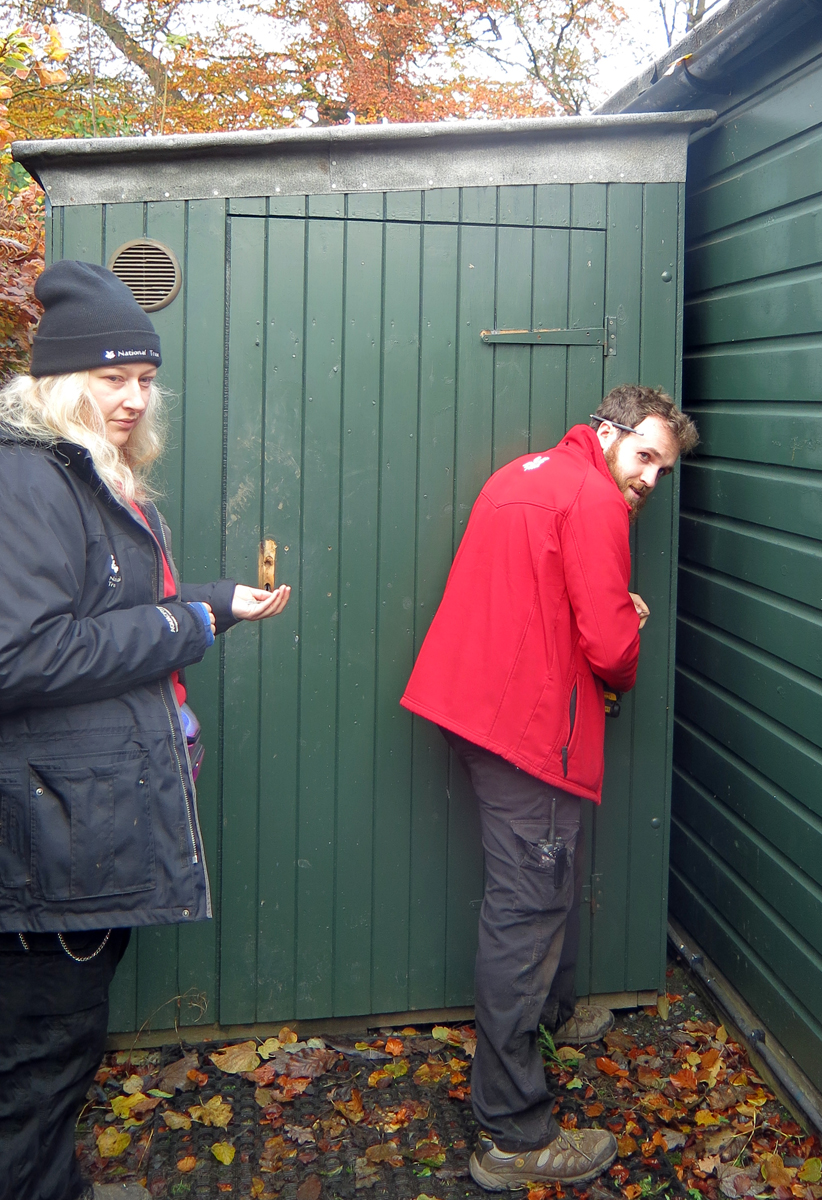
Early November brought our first frost of the season. The day began with a little breaking and entering as the keys to the tool store were missing. This necessitated the removal of the door before our work could begin. Once access was gained, we became a team of road menders. Like many roads elsewhere, the roads and paths of Gibside have become pothole ridden. After clearing the ice and water from the potholes the task of filling them could begin. This involved transporting wheelbarrow full of stone chippings to each site, filling the holes and tamping the chippings down.                     

Breaking and entering

Thinking about it!

Frosty grass on Park Fields
Brushing water out of pothole prior to filling it.
Finished - can you see the join?

Finally a bit of Autumn colour

Monday, 7 October 2019

September 2019


Twenty five or so cattle bunched together in Park Field putting up enough insects to attract swooping swallows that were absent from the rest of the field.


I was having an early wander. Of course, Gibside is primarily for the public but it was lovely to potter around by myself before the visitors arrived and when the rest of the team were already at work elsewhere.

Attacking the Himalayan balsam on Ladyhaugh
Before - silver birch surrounds the hazel plantings
The team hard at work - West Woods


It had obviously been a while since I last visited the lower West Wood track. It now has a number of exercise installations known, apparently, as West Wood Workout. They’re a bit like climbing frames for big people. Not tempted to give it a try, I sat on a seat on the other side of the track listening to the wind in the trees and enjoying the woodland light.


The rest of the team had passed through this way earlier and tidied up the Den Building Area. I caught up with them in time for a tree stump sit, a cup of coffee and conversation where they were working at clearing self-seeded birch and sycamore around hazel planted a few years back.

Bronze Shieldbug nymph 
Ladybird
Shaggy parasol

As quiet and people-free as my wanderings had been, I only saw and heard the occasional bird. I thought I might at least have spotted a roe deer or startled a brown hare – but not today. There was a buzzard, though, and a red kite overhead as we worked. It would be a rare occurrence not to see and hear them in West Wood. And there were badger diggings edging the upper track. This is often the case. Tracks work as well for badgers to get around as they do for humans, and the narrow margin of cut grass beside the track is ideal for rooting about in.

Hypogymnia physodes

Hoverfly - Syrphus ribesii

Raking grass on The Avenue bank


We’d had two weeks of clearing birch, sycamore and other growth to eliminate competition for the hazel. It’s quite an enjoyable task, but hard, tiring work. The following week, we got the easier job of feathering the lime trees by the Walled Garden that is, removing the epicormic growth. Epicormic growth is the suckers that shoot out from the bark close to the base of the tree. Whilst we were doing that, three young grey squirrels innocently played above our heads and around our feet, looking cute. But that won’t save them.

Lime tree showing epicormic growth


Feathering the lime tree


Almost complete
Honey fungus at base of tree
Honey fungus


Young squirrels hunting acorns
Steve Wootten & Phil Coyne

Wednesday, 28 August 2019

Getting down to it

July and August 2019


Weeding heather

It’s an odd thing to be weeding around heather. You don’t see anybody doing that on the moors around Rothbury. But our patches of heather at Gibside are constantly invaded by other species. Even the well-established area at the north end of the Hollow Walk benefits from the occasional clear-out of birch, bramble and the dreaded western hemlock. Two or three patches are now better able to look after themselves, but more recently planted areas need a bit of gardening. Some might think it wrong to be interfering in this way, but really, it’s what we do at Gibside – as is done in many other ‘natural’ habitats: we give nature a helping hand. And that includes encouraging variety as well as ridding the place of plants that just don’t belong.

Before weeding

After weeding - heather now visible


Field assessment

More often than not, identifying plants is more a test of the ageing memory than it is of field botany knowledge. Joining in with the rangers, though, on hands and knees in sheep-chomped fields trying to spot and then put a name to the remaining bits of vegetation in any given metre square was, indeed, a challenge. We were replicating a Field Assessment made four years ago. A field assessment is a sort of plant quality survey of Gibside’s farm fields. Whilst it’s perfectly acceptable to note anything growing, the main purpose is to check out the presence of a number of indicator species
What's that flower?

Positive indicators include Bird’s foot trefoil, Meadow buttercup, Selfheal, Red clover, White clover, Germander speedwell and many more. The negative indicators are few: Broad-leaved dock, Stinging nettle, Soft rush, Thistles and Ragwort.
Birds foot trefoil
Red clover

White clover

Self heal

The data is in but, like all statistics, requires professional interpretation. It looks encouraging, though.


Tick monitoring

Working with Gibside’s rangers invariably takes us off the tracks and into the woods and other wild places where visitors tend not to go. Losing ourselves amongst nature is one of the main reasons for working as a Conservation Volunteer, but it has its drawbacks. It’s like this: we love nature but we hate ticks. They’re nasty little things with unpleasant eating habits and, worst still, can be carriers of some horrible diseases. And the population is growing.

A few years back, researchers at Liverpool University set up a project to assess the distribution of the various species of ticks across the nation. We thought we’d have a go at Gibside and borrow their strategy to do so. This involves dragging a metre square white sheet across vegetation for ten metres in one direction, then turning around and dragging it back again and counting how many ticks have been picked up. We’re not attempting to identify them, just count them. Of course, you don't get them all, but we can, hopefully, get a density comparison across the estate. We’re just at the learning stage. Or, put another way, we haven’t caught many. Maybe there aren’t many to catch. That would be a good thing.

The tick collector at work

Betony in bloom on The Avenue bank
This year has been a good year for some species of butterfly, in particular, Painted lady butterflies.

A Painted lady butterfly

A Red admiral butterfly
And now as Autumn approaches mushrooms are starting to make an appearance...

A group of Shaggy parasol mushrooms

Another task assigned to our team was helping to eradicate Himalayan balsam from the estate. We try really hard but are helpless against the exploding seed heads.

Terry surrounded by head height bracken
 attempts to remove the Himalayan balsam. 

Steve Wootten & Phil Coyne