Sunday, 22 July 2012

Invasive Species

During the summer months our rangers and volunteers spend a great deal of their time controlling invasive plant species.  Invasive plants are robust and fast growing and if not controlled spread rapidly shading out more delicate flowering species.  Many are non-native having been brought here as colourful additions to parks and gardens.  Examples include rhododendron, japanese knotweed and himalayan balsam.

Japanese knotweed

Japanese knotweed grows typically 2m to 3m tall at a rate of up to 10cm a day and is difficult to control as tiny fragments of root can grow into living plants.  The stems are rather like bamboo shoots, the leaves large and and spikes of tiny white flowers are produced in late summer.  It is best treated with a herbicide although even then repeat applications may be required.


Volunteer Mathew pulling himalayan balsam

Himalayan balsam is a member of the bizzie lizzie family and grows rapidly to a height of up to 2m or even more in favourable sites.  The stems are very succulent, the large leaves spear-shaped and pinkish flowers are shaped like an old fashioned policeman's helmet giving rise to its alternative common name.  A shallow root system makes this an easy plant to control simply by hand pulling.


Rhododendron

Rhododendron is an evergreen shrub with dark green leaves and attractive large purplish blooms.  We contol this by cutting back stems with saws and loppers and treating the stumps with an herbicide to prevent re-growth.


The bees are back in town!

The observation beehive in the corner of the Walled Garden
The beekeepers of the Newcastle Beekeepers Association brought a colony of honey bees back to our observation hive this weekend.  The bees have been overwintering in another hive at Gibside's Cut Thorn Farm.  Usually they would have been back in the observation hive much earlier in the summer, but because of the unseasonable weather, it was safer to leave them at the farm.  The beekeepers were waiting until the weather was fine for a few days running, so that the bees had time to orientate themselves in our Walled Garden.
Open the door of the hive and watch the bees at work
There are more conventional hives in the corner of the garden, behind the pond, but the observation hive has doors to open on each side, so you can watch the bees working inside the hive through a perspex window. 

Next time you're at Gibside have a look in the hive and see if you can spot the queen bee.

Up close with honey bees
There is a chimney up the side of the hive which has two pipes running through it.   At the back of the hive, at about two metres high, the pipes emerge and this is how the bees get in and out of the hive.  It is designed so that the bees go in and out above human head height, so they don't come into contact with people. 
The entry and exit holes for the hive
Once they come out of the pipe, they can make their way to the nearest flowers in the garden.  The herbaceous border which runs along the wall from the greenhouses was planted with bees and butterflies in mind, and it contains lots of nectar-rich flowers.


Saturday, 21 July 2012

Pumping our troubles away!

Since the flash-flooding of two weeks ago our team has been working flat out to try and get all our paths repaired and open for visitors.  We have also had many culverts to unblock after the huge amount of rain washed branches and sand down the streams and blocked up the drainage systems.  We managed to get all the paths reopened this week, after repairing some of them more than once when the rain kept coming.

One culvert that gave us trouble was a pipe that takes the Leap Mill Burn under the main drive.  Any visitors to Gibside will have noticed the pool at the side of the drive growing over the last week or so. 


The pool at it's height

 There was water coming through the other end of the pipe, but everytime the water level dropped, an overflow futher upstream would open and more water gushed down.


Overflow water from the near-by town of Burnopfield
We needed to open up the culvert to let the water through before the pressure of the water washed the road away, but to access the culvert, we needed to get rid of the water.  So we hired a huge pump.

This pumped water at 500 gallons per minute.  We thought it would be clear enough for us to get to the culvert entrance in a few hours.  Well, it took 11 hours with the pump running constantly for the level to drop enough for us to see the blockage!  Although there was some water getting out through the culvert pipe, the burn was constantly running and filling up the pool. 

When we could finally get down to digging, we found that the pipe entrance was covered with logs and branches, and the silt had built up behind them.  Some of the logs were huge, and we needed a winch to lift them out.

A few of the muddy logs and branches that we removed form the blockage.
  By 10.30pm we had the culvert running well, and we decided to call it a day.  We all went home shattered and covered in mud to have nightmares of the culvert re-blocking and the pool filling up again.

The entrance to the culvert
 Thanks to the late night of hard work we had cleared enough debris so the culvert kept flowing and the flow helped to clear a lot of the smaller twigs and silt.  You can just see the green metal box at the top left of this photo, which was surrounded with water in the first photo.  The pool of water that collected must have been 12 feet deep.

Since then the sun has come out, and we're hoping it stays that way - we've seen enough rain and mud to last for a while!


Sunday, 3 June 2012

An Otter Holt and a Red Squirrel

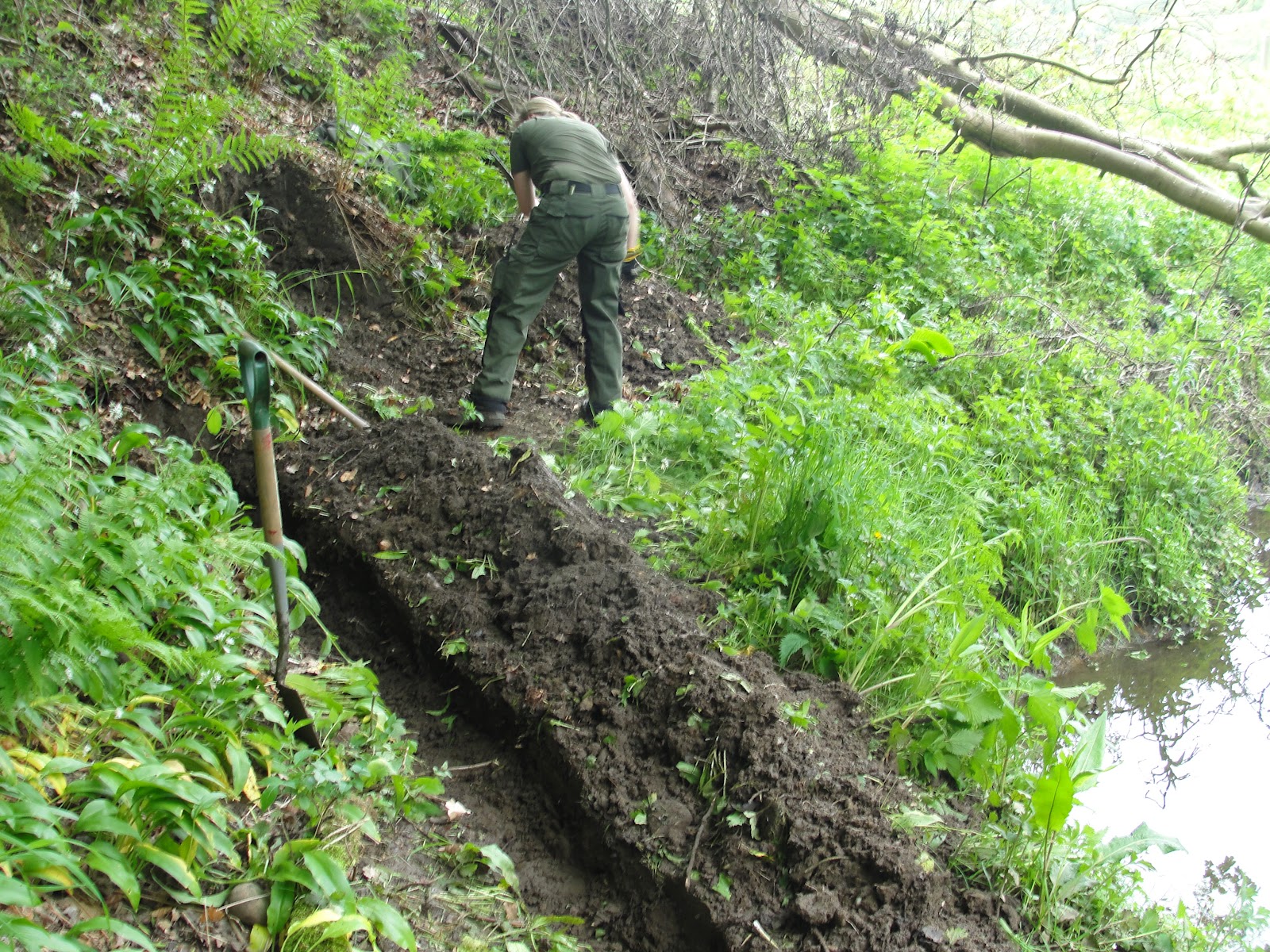
Our rangers have been busy installing an otter holt in a bankside by the river.  The holt consists of a pre-formed square plastic chamber with two separate entrances vice rigid plastic pipes.  The holt was dug into the bankside and completely covered with the excavated soil - lots of strenuous digging and back-filling but well worth the effort if it provides a safe haven for the elusive but charming otter.

Plastic chamber for otter holt


Ranger Vicky digs hole for chamber


Ranger Phil digs channel for second pipe
  

I set up a motion sensored video camera overlooking a badger sett recently having scattered a handful of peanuts around one of the entrances.  Footage was captured of a pair of badgers and also an inquisitive fox but the highlight was a short sequence of a red squirrel - proof at least that these delightful squirrels are still present at Gibside.


Sunday, 27 May 2012

Gibside's Flora

Early spring flowers like bluebells, primroses, wood sorrel and anemone have just about finished flowering now.  

Primrose
Toothwort, a parasitic plant growing from the roots of trees and shrubs is also at the end of its flowering period. 

Toothwort
As the year progresses however these will be replaced by a succession of other colourful plants.  At present you may come across bugle and ground ivy.

Bugle

Ground ivy
Another plant you may find in 'flower' is cukoo pint, also known as lords-and-ladies.  The club-like flowering part of this plant is known as a spadix and is enclosed by a curled leaf-like bract known as a spathe.


Lords-and-ladies


Later in the year look out for the very common yellow flowering wood avens and the more showy apricot coloured flowers of water avens.


Water avens

You should also come across the flowering spikes of common spotted orchids and the less numerous northern marsh orchid from June onwards. 


Northern marsh orchid

Common spotted orchid

If you'd like to see these and more of Gibside's flora you can join one of our rangers on a 'Wildflower walk' on Sunday June 24th at 2.30pm.

Wednesday, 16 May 2012

Wildlife Survey: Cherryburn

Tuesday 15th May 2012

Seasonal Affective Disorder belongs to February; eight degrees and no sunshine in the middle of the day in the middle of May just isn’t right ( we shouldn't really have been suprised, it wasn't a Wednesday after all).
Nevertheless, we seasoned wildlife surveyors were not to be deterred from our mission to catalogue the flora and fauna of the wilder parts of Cherryburn. Whilst no doubt benefitting from the plentiful rain of recent, our flowering plants could really do with a bit of warmth to meet seasonal norms - and make identification easier.
Wildlife Recorder at Work

Edge of Cherryburn Dene

Much of the property is house, garden and paddock, but there is also a dedicated Wildlife Garden and a surprising area of other wildlife-friendly land in the hedgerows to the west and the strip of woodland along the dene on the east and north sides. And, to encourage birds and bats, NT Rangers have been putting up an assortment of boxes in the trees.
A new home

Common Sorrel

English Bluebell
Our survey revealed no surprises in the plant population, but we were treated to being watched over by a tawny owl as four red kites circled overhead.

A Tawny Owl keeps an eye on us

Hawthorn Blossom
Ribwort Plantain

Forgetmenot carpet
Dog Violet


Tuesday, 15 May 2012

Of Badgers, Foxes and Woodpeckers

I spent a pleasant evening this week badger watching.  I can usually predict the times of emergence having been watching them now for a number of years so this means I can do a spot of deer 'stalking' with camera before settling into place to watch the badgers with just a little time to spare.


Roe buck

The first badger emerged just ten minutes after I had settled down and almost immediately disappeared up and over an embankment only to return dragging some fresh bedding back to the sett.  This was repeated four times until a second badger emerged and together they began a spot of social grooming.  A little while later the first cub appeared and this was soon joined by another and a playful bout of rough and tumble followed.  Two other cubs were to join in the games and it was hard to keep track of each of them as they chased, pounced and nipped each other.


Mother badger (facing) with four cubs
  
Mid week I checked one of the dens where foxes usually rear their cubs.  An earlier check had revealed trampled vegetation around the entrance holes so I was sure cubs were present.  I was lucky on this occasion to spot two cubs as they briefly appeared at one of the holes so I decided to set up a remote camera to record any activity.  Footage revealed five cubs to be present which were, like the badger cubs, at a very playful age with bouts of pouncing, tumbling and fighting.  Sadly two of the cubs were later found dead outside the main entrance hole with no obvious marks to suggest the cause of death.

The great tits at the stables have now hatched their eggs and are busy feeding the six hungry chicks with good views of them transmitted via the installed camera.  A group of visitors had a shock while watching the live footage when wood chips began showering down onto the nest and young.  A little while later a woodpecker's head appeared inside the box and snatched one of the young chicks from the nest.


Great spotted woodpecker
Woodpeckers can be voracious predators of both eggs and young birds and no doubt this one wood have returned to take the rest of the brood so we covered the nest-box with a cage of wire netting.  The netting was of a size that prevented the woodpecker from gaining entry to the box but the parent birds were able to slip through the mesh and so still feed their young,  It has certainly been an eventful week.