Sunday, 3 June 2012

An Otter Holt and a Red Squirrel

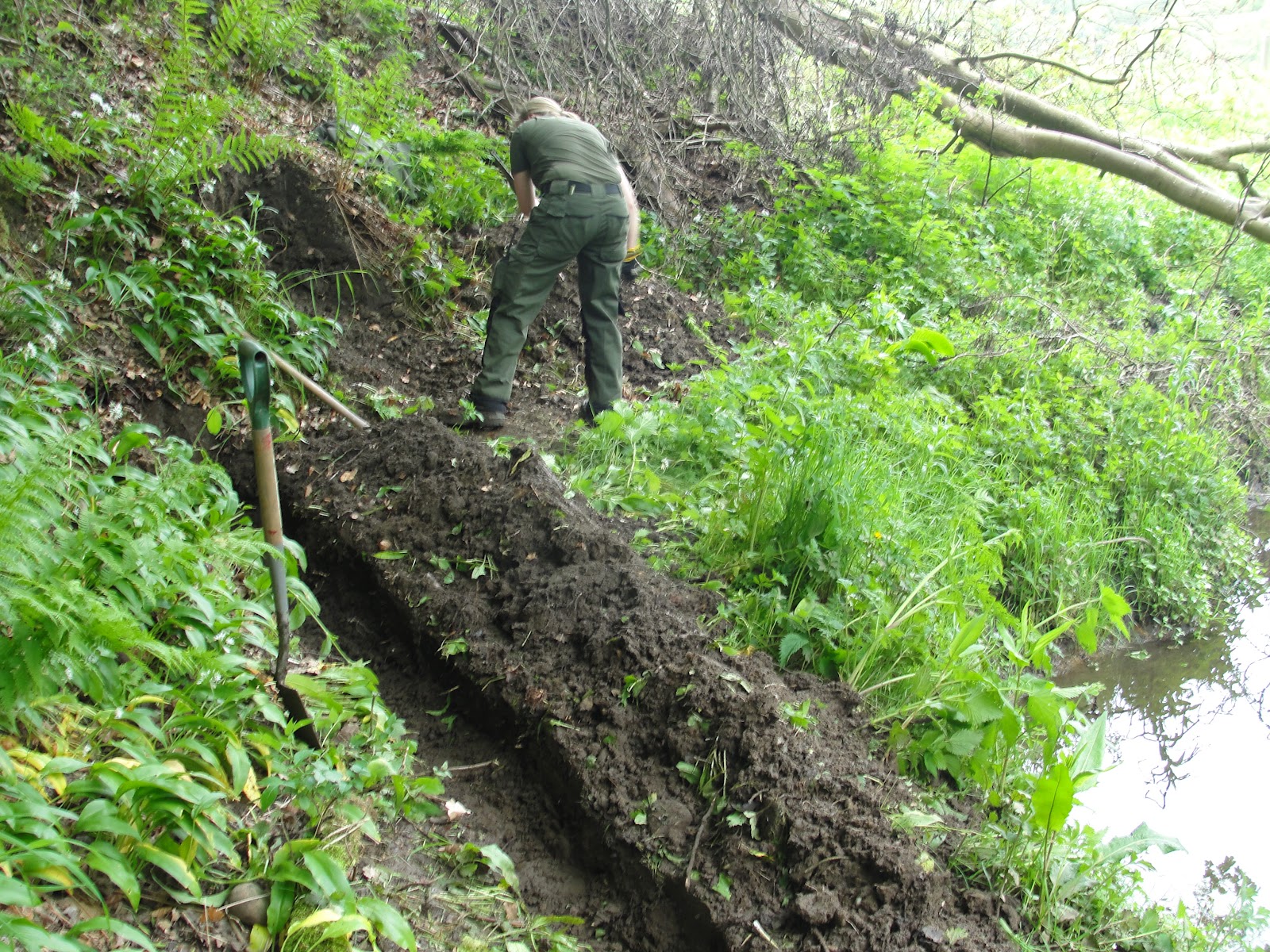
Our rangers have been busy installing an otter holt in a bankside by the river.  The holt consists of a pre-formed square plastic chamber with two separate entrances vice rigid plastic pipes.  The holt was dug into the bankside and completely covered with the excavated soil - lots of strenuous digging and back-filling but well worth the effort if it provides a safe haven for the elusive but charming otter.

Plastic chamber for otter holt


Ranger Vicky digs hole for chamber


Ranger Phil digs channel for second pipe
  

I set up a motion sensored video camera overlooking a badger sett recently having scattered a handful of peanuts around one of the entrances.  Footage was captured of a pair of badgers and also an inquisitive fox but the highlight was a short sequence of a red squirrel - proof at least that these delightful squirrels are still present at Gibside.


Sunday, 27 May 2012

Gibside's Flora

Early spring flowers like bluebells, primroses, wood sorrel and anemone have just about finished flowering now.  

Primrose
Toothwort, a parasitic plant growing from the roots of trees and shrubs is also at the end of its flowering period. 

Toothwort
As the year progresses however these will be replaced by a succession of other colourful plants.  At present you may come across bugle and ground ivy.

Bugle

Ground ivy
Another plant you may find in 'flower' is cukoo pint, also known as lords-and-ladies.  The club-like flowering part of this plant is known as a spadix and is enclosed by a curled leaf-like bract known as a spathe.


Lords-and-ladies


Later in the year look out for the very common yellow flowering wood avens and the more showy apricot coloured flowers of water avens.


Water avens

You should also come across the flowering spikes of common spotted orchids and the less numerous northern marsh orchid from June onwards. 


Northern marsh orchid

Common spotted orchid

If you'd like to see these and more of Gibside's flora you can join one of our rangers on a 'Wildflower walk' on Sunday June 24th at 2.30pm.

Wednesday, 16 May 2012

Wildlife Survey: Cherryburn

Tuesday 15th May 2012

Seasonal Affective Disorder belongs to February; eight degrees and no sunshine in the middle of the day in the middle of May just isn’t right ( we shouldn't really have been suprised, it wasn't a Wednesday after all).
Nevertheless, we seasoned wildlife surveyors were not to be deterred from our mission to catalogue the flora and fauna of the wilder parts of Cherryburn. Whilst no doubt benefitting from the plentiful rain of recent, our flowering plants could really do with a bit of warmth to meet seasonal norms - and make identification easier.
Wildlife Recorder at Work

Edge of Cherryburn Dene

Much of the property is house, garden and paddock, but there is also a dedicated Wildlife Garden and a surprising area of other wildlife-friendly land in the hedgerows to the west and the strip of woodland along the dene on the east and north sides. And, to encourage birds and bats, NT Rangers have been putting up an assortment of boxes in the trees.
A new home

Common Sorrel

English Bluebell
Our survey revealed no surprises in the plant population, but we were treated to being watched over by a tawny owl as four red kites circled overhead.

A Tawny Owl keeps an eye on us

Hawthorn Blossom
Ribwort Plantain

Forgetmenot carpet
Dog Violet


Tuesday, 15 May 2012

Of Badgers, Foxes and Woodpeckers

I spent a pleasant evening this week badger watching.  I can usually predict the times of emergence having been watching them now for a number of years so this means I can do a spot of deer 'stalking' with camera before settling into place to watch the badgers with just a little time to spare.


Roe buck

The first badger emerged just ten minutes after I had settled down and almost immediately disappeared up and over an embankment only to return dragging some fresh bedding back to the sett.  This was repeated four times until a second badger emerged and together they began a spot of social grooming.  A little while later the first cub appeared and this was soon joined by another and a playful bout of rough and tumble followed.  Two other cubs were to join in the games and it was hard to keep track of each of them as they chased, pounced and nipped each other.


Mother badger (facing) with four cubs
  
Mid week I checked one of the dens where foxes usually rear their cubs.  An earlier check had revealed trampled vegetation around the entrance holes so I was sure cubs were present.  I was lucky on this occasion to spot two cubs as they briefly appeared at one of the holes so I decided to set up a remote camera to record any activity.  Footage revealed five cubs to be present which were, like the badger cubs, at a very playful age with bouts of pouncing, tumbling and fighting.  Sadly two of the cubs were later found dead outside the main entrance hole with no obvious marks to suggest the cause of death.

The great tits at the stables have now hatched their eggs and are busy feeding the six hungry chicks with good views of them transmitted via the installed camera.  A group of visitors had a shock while watching the live footage when wood chips began showering down onto the nest and young.  A little while later a woodpecker's head appeared inside the box and snatched one of the young chicks from the nest.


Great spotted woodpecker
Woodpeckers can be voracious predators of both eggs and young birds and no doubt this one wood have returned to take the rest of the brood so we covered the nest-box with a cage of wire netting.  The netting was of a size that prevented the woodpecker from gaining entry to the box but the parent birds were able to slip through the mesh and so still feed their young,  It has certainly been an eventful week.


Thursday, 10 May 2012

The Wood Pile

Wednesday 9th May 2012

To tidy an unsightly bend in the track near the Bothy, we moved scattered logs and other bits of timber to build log piles in the nearby woods, creating a habitat that should encourage invertebrates. The move did disturb a few toads and other creatures, but we did our best to ensure they still had the protection of a suitable home. Many of the logs were already well rotted and carried the fruiting heads of a number of fungi.

Wood Pile
The Slime Mould (Lycogala epidendrum)

Fungal fruiting body

The environmentally friendly scythe

Wednesday 9th May 2012

Compared to the strimmer, there is much to be said in favour of the scythe. Strimmers are noisy beasts that are given to disturbing the wildlife and shattering the very peace that brings visitor and many a conservation volunteer to Gibside in the first place. Light, easy to carry, easy to use, the scythe requires no polluting carbon fuels, produces no noxious gases, nor leaves any environmentally damaging bits of itself behind – unlike the guilty strimmer.


Scything in action

With instruction from Gibside’s very own scythe enthusiast, John Grundy, we soon got into the swing of it and set off to hone our new skills cropping the grass along the edges of the ride by the Octagon Pond. We could choose to avoid destroying the rarer wild flowers, give frogs, toads and other creatures time to get out of the way, listen to the birds sing and even hold a conversation. I don’t remember John mentioning blisters, though but.

Friday, 4 May 2012

Tree Planting at Snipes Dene

Wednesday 2nd May 2012

Snipes Dene has been cleared of non-native conifers, and our task today was to plant out oak saplings (over 100!), 1 small beech tree, 2 hazels and 2 willows.
The first task was to load up the plant pots containing the saplings onto the truck and then it was off to Snipes Dene.

Dave digs a hole
The oaks were planted 5 to 10 metres apart, the beech was planted near to the road (well it was in a large, heavy pot!), the hazels were planted on top of a mound and the willows were planted near to the stream.

One of the planted oak saplings

After a quick lunch back at the Pontop shed we loaded up the final 34 oak saplings and headed back to Snipes Dene to finish off the task.  
Bugles (Ajuga replans) in Snipes Dene